Project case study
ML - Sports · 2025
NFL Kicker Field-Goal Make Probability Model (Ensemble ML)
A calibrated ensemble machine learning system that estimates NFL field-goal make probabilities using play-by-play, weather, and stadium context, designed for real decision support rather than binary prediction.
Highlights
- Engineered contextual and environmental features including distance, wind, rain, roof state, and high-pressure situations.
- Trained and evaluated a diverse suite of probabilistic models with an emphasis on calibration and decision quality.
- Built a weighted ensemble that outperformed all single models in accuracy, calibration, and robustness.
Gallery
What
Built a machine learning system to estimate the probability that an NFL field goal attempt will be successful.
The objective was to produce calibrated probabilities that can plug directly into decision tools such as expected points, win probability, and fourth-down strategy models.
How
Constructed a dataset of NFL field goal attempts using historical play-by-play, stadium, and weather data spanning multiple seasons.
Engineered key contextual features including kick distance, wind speed, precipitation indicators, roof state, surface type, and pressure-sensitive game situations.
Trained multiple probabilistic models including Logistic Regression, Bayesian Logistic Regression, GAMs, Bagging, LightGBM, and Bayesian Additive Regression Trees (BART).
Applied distance-aware calibration and built a weighted ensemble that combines model probability outputs to improve robustness in unusual or high-leverage scenarios.
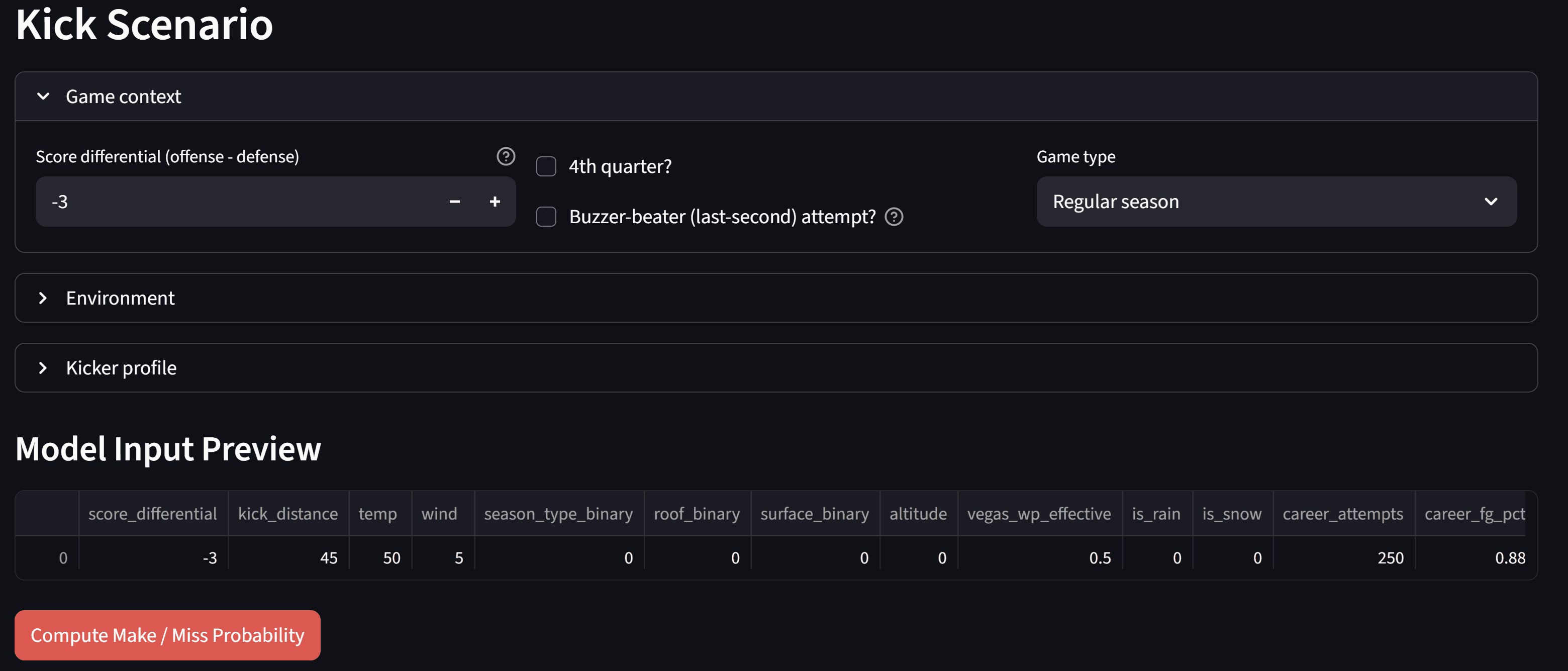
Designed and deployed an interactive Streamlit application that allows users to input kick conditions and receive real-time probability estimates.
Results
Achieved a best-in-class Brier Score of 0.10976 using a weighted ensemble, outperforming all individual models.
Delivered strong discrimination and reliability with AUC = 0.7636, PR-AUC(miss) = 0.3192, and ECE@10 = 0.0131.
Demonstrated that ensembling reduced variance and improved stability, particularly in edge cases where single models were overconfident or poorly calibrated.