Project case study
ML - NLP · 2026
Financial Event Intelligence Agent
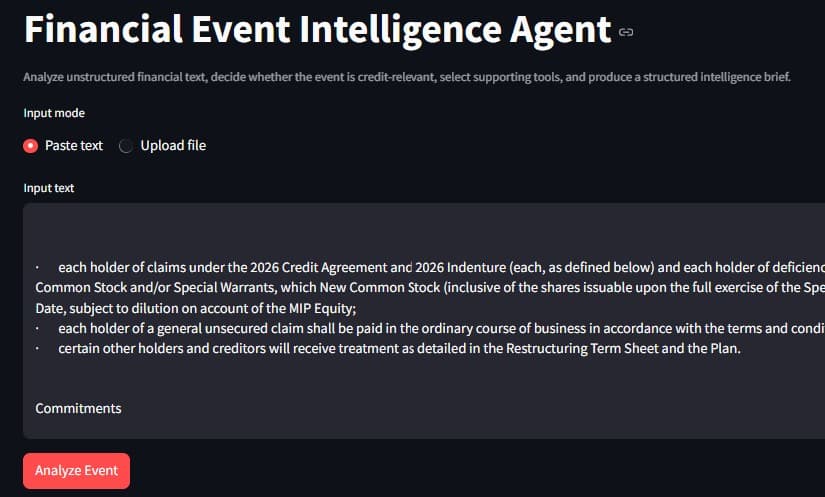
Agentic financial intelligence system that reads unstructured documents, decides what matters, selectively gathers supporting context, and produces structured analyst briefs for credit-relevant events.
Highlights
- Built a lightweight agent loop that classifies events, assesses importance, identifies uncertainty, and chooses tools before finalizing a brief.
- Supports multiple document types including text, JSON, PDF, and DOCX for realistic financial-document ingestion.
- Outputs both analyst-style narrative briefs and structured JSON with severity signals, confidence drivers, escalation rationale, and next steps.
Gallery
What
This project explores what a lightweight agent can do beyond a standard chatbot or RAG workflow in a financial intelligence setting. Instead of only summarizing text, the system reads an event-driven document, determines whether it is credit-relevant, assesses importance, and decides whether additional context is needed before producing a final view.
The goal was to prototype a more analyst-like workflow for triaging restructurings, refinancing events, legal developments, liquidity concerns, and other market-moving signals from messy unstructured documents.
How
I built a modular Python system with a parser layer, agent layer, local tool layer, and structured output models. The agent forms an initial event view, checks whether confidence is strong enough to finalize, selectively calls tools such as entity normalization, risk-signal scanning, and event-rule lookup, and then refines its assessment.
To make the system practical for demo and product thinking, it supports multiple input formats including plain text, JSON, PDF, and DOCX. Final outputs include both a readable analyst brief and machine-friendly structured JSON.
Results
The final system can identify event type, importance, credit relevance, escalation need, severity signals, confidence drivers, and recommended next steps from real-world style financial documents. It also logs decision steps in a concise way so the workflow is explainable during demos.
The project demonstrates a more differentiated agentic pattern than a simple portfolio RAG app by showing explicit branching, tool selection, uncertainty handling, and structured intelligence generation.
Key Takeaways
In financial intelligence workflows, the challenge is not only retrieving text but deciding what matters, when confidence is insufficient, and what extra context is worth gathering before escalating an event.
A small, focused agent can already add meaningful structure to unstructured financial documents without needing a huge multi-agent stack or overengineered infrastructure.