Project case study
Sports · 2024
Systemic Bias in College Football Playoff Rankings
A simulation-based study of how preseason rankings and perception-driven biases propagate through College Football Playoff rankings, affecting accuracy, volatility, and playoff access.
Highlights
- Simulated inverse preseason rankings to quantify how perception bias propagates through a season.
- Designed and compared standard vs outcome-driven (harsher) committee scoring systems.
- Evaluated tradeoffs between ranking accuracy, stability, and fan-facing volatility.
Gallery
What
Studied how perception-driven biases such as preseason rankings and media narratives influence College Football Playoff rankings.
Focused on how incorrect initial beliefs propagate through rankings and affect playoff access, accuracy, and fairness.
How
Built simulation models representing both a small controlled league and the full 134-team FBS ecosystem.
Initialized rankings using an intentionally inverted preseason poll to stress-test ranking inertia.
Defined probabilistic game outcomes based on true team strength differentials.
Designed a CFP-style points system and compared a standard committee approach against a harsher, outcome-driven variant.
Tracked ranking evolution using custom metrics including AvgDiff, MaxDiff, MaxRise, and Top-25 specific accuracy measures.
Results
Found that preseason bias meaningfully persists under conservative ranking systems, even with correct on-field outcomes.
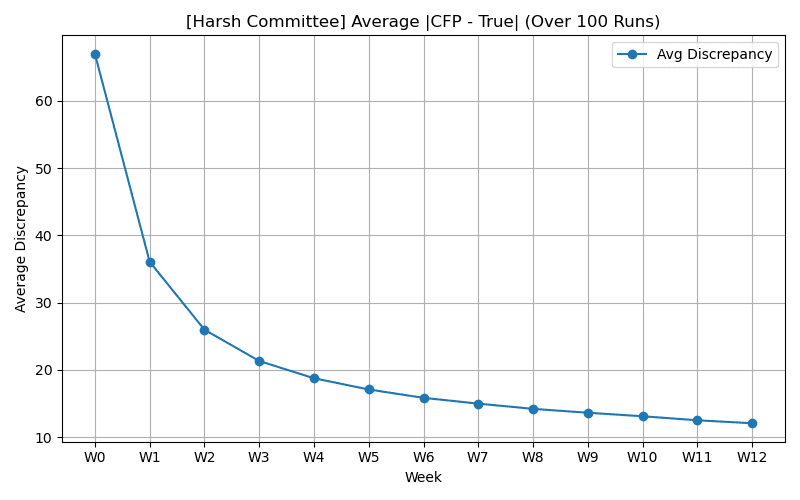
Demonstrated that harsher, performance-driven committees converge to true team strength faster but introduce greater early-season volatility.
Quantified tradeoffs between ranking accuracy, stability, and fan-facing excitement, highlighting structural disadvantages for lower-perception teams.