Project case study
ML - Finance · 2025
Blockchain Fraud Detection with Graph & Unsupervised Anomaly Models
Unsupervised fraud detection pipeline for Ethereum transfers that combines graph-based network features with anomaly-scoring models to surface suspicious activity at scale.
Highlights
- Parsed millions of Ethereum transfers into shard-aware transaction networks.
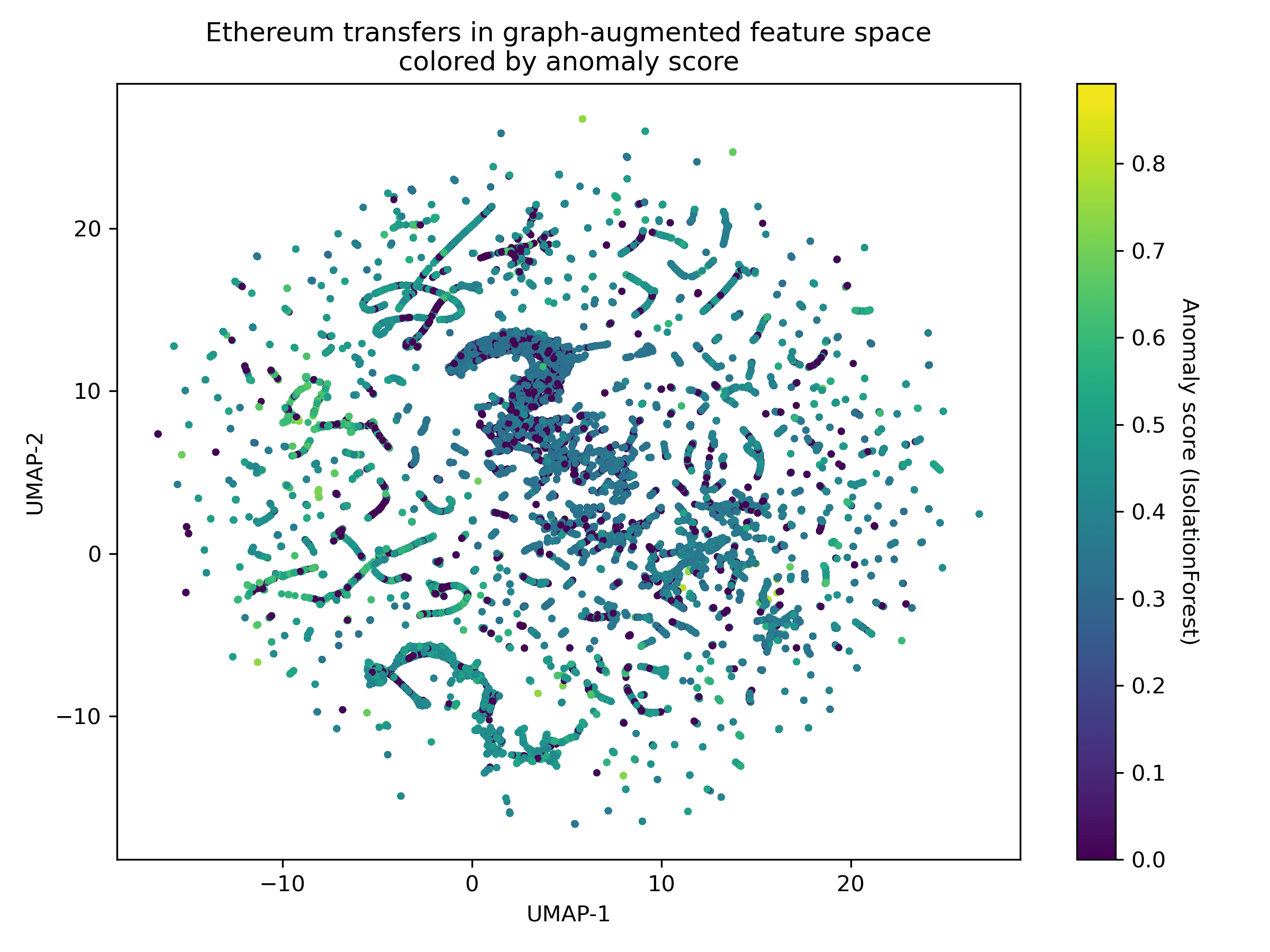
- Combined graph-structural features with autoencoder reconstruction error and Isolation Forest scores.
- Produced ranked, threshold-adjustable anomaly outputs for adaptive fraud detection.
Gallery
What
Built an unsupervised fraud detection system for Ethereum transactions that identifies anomalous behavior without labeled fraud data.
The goal was to surface suspicious addresses and transfers by combining behavioral anomalies with graph-structural signals.
How
Parsed millions of Ethereum transfers, engineered address-level graph features, and constructed shard-aware transaction networks.
Trained an autoencoder, Isolation Forest, and KMeans to model normal transaction behavior using reconstruction error and anomaly scores.
Computed node-level network metrics and combined them with model outputs to produce unified risk scores.
Results
Developed a threshold-adjustable anomaly detection pipeline that adapts sensitivity based on risk tolerance.
Generated ranked anomaly outputs and demonstrated that graph features materially improved the stability and distinctiveness of fraud detection.